Understanding ship specifications is critical for naval architects, ship operators, marine engineers, shipowner, students, and maritime enthusiasts.
Specifications describe a vessel’s size, capacity, performance and regulatory characteristics. This article explains the most important ship specifications, why they matter, and gives the core formulas used to calculate them.
Read on to learn clear definitions, units, industry context and simple worked examples you can use to check numbers or start deeper analysis.
Why ship specifications matter
Compliance: Classification societies and flag states require specific documented dimensions and capacities.
Safety and stability: Proper weight and volume data support safe loading and intact/damaged stability analyses.
Commercial performance: Cargo capacity, fuel consumption and speed impact operating costs and revenue.
Design & procurement: Accurate specs let owners compare ships, order equipment, and schedule maintenance.
Main ship specifications and definitions
The following list covers the common specifications you’ll see in ship data sheets and certificates.
Principal dimensions
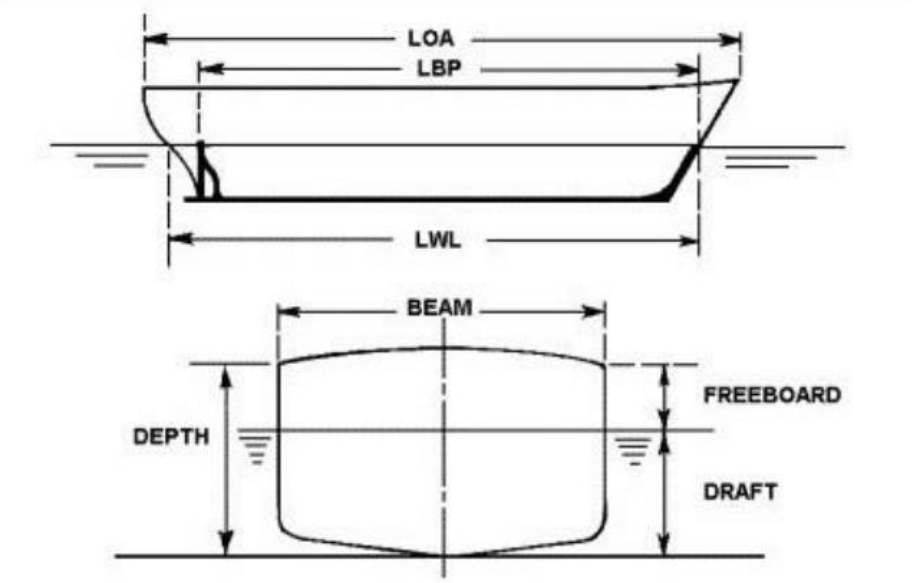
Length Overall (LOA): The maximum length from the foremost to rearmost point of the vessel (m). Used for berth planning and canal passage fees.
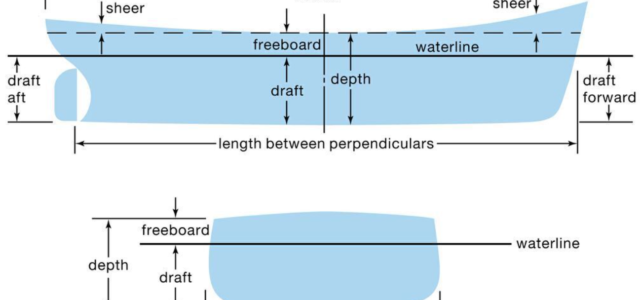
Length Between Perpendiculars (LBP or LPP): Distance between the forward and aft perpendiculars, typically measured at the design waterline (m). Important in hull form and hydrostatic calculations.
Beam (B): Maximum breadth of the hull (m). Affects transverse stability and cargo/stowage layout.
Depth (D): Vertical distance from the base line (keel) to the deck at amidships (m). Used for structural design and tonnage approximations.
Draft (T): Vertical distance between the waterline and the bottom of the keel (m). Critical for under-keel clearance, canal/port access, and hydrostatic calculations.
Tonnage and volume measurements
Gross Tonnage (GT): A dimensionless index of a ship’s enclosed volume calculated per the International Convention on Tonnage Measurement. GT affects port dues, safety rules and manning requirements.
Net Tonnage (NT): Derived from GT, reflects the volume of cargo-carrying spaces; used for commercial charges.
Deadweight (DWT): The total weight a ship can carry including cargo, fuel, stores, crew and provisions (metric tonnes). DWT = Loaded Displacement − Lightship Displacement.
Lightship (Lightweight): The weight of the ship itself without any cargo, fuel, water, passengers, crew or stores (t). Used to compute DWT and loadline.
Displacement and stability-related weights
Displacement (Δ): Total mass of the vessel submerged, equal to the weight of water displaced at the current draft (metric tonnes).
Centre of Gravity (KG): Vertical distance from baseline to the ship’s center of gravity (m). Together with the center of buoyancy, KG determines stability.
Metacentric Height (GM): Distance between the center of gravity (G) and the metacentre (M). GM is an indicator of initial transverse stability (m). A positive GM is required for stable equilibrium.
Speed and propulsion parameters
Service Speed: The designed operational speed under typical service conditions (knots).
Maximum (Trial) Speed: The highest speed measured during sea trials, often under light conditions (knots).
Installed Power: Total propulsion installed power, usually in kW or kSHP (shaft horsepower).
Specific Fuel Consumption (SFC): Fuel burned per unit power per time, e.g., g/kWh. Used to estimate range and bunkering needs.
Capacity and cargo-related specs
Cargo Capacity (m3 or tonnes): For bulk carriers, cubic meters or mass of cargo; for container ships, TEU capacity (twenty-foot equivalent units).
Ballast Capacity: Volume/weight of ballast water tanks used to maintain proper trim and stability when unladen.
Tank Capacities: Fuel oil, lube oil, fresh water and other tank volumes (m3).
Structural and regulatory specs
Freeboard: Vertical distance from waterline to main deck level at the side of the ship. Affects loadline and seaworthiness.
Loadline (Plimsoll) Mark: The assigned maximum draft under various conditions.
Classification Society & Flag: The organization that classifies the ship (e.g., DNV, ABS, LR) and the flag state; both affect surveys, statutory certificates and allowed trades.
Key formulas and how to use them
Ship Specifications Quick Calculator
Basic dimensions and hydrostatics
Weights and consumables
Stability, trim and propulsion
Propulsion and fuel
Display and actions
Results
Below are essential calculation formulas used for quick checks and basic design/operational computations. Units shown are the most common; convert as needed.
Archimedes’ principle (Displacement)
Basic statement: Weight of ship = Weight of displaced water
Δ = ρ_water × V_disp
Where:
Δ = displacement (tonnes; 1 tonne = 1,000 kg)
ρ_water = density of water (t/m3). Seawater ≈ 1.025 t/m3; freshwater ≈ 1.000 t/m3
V_disp = submerged volume (m3)
Example: A hull displaces 20,500 m3 in seawater. Δ = 1.025 × 20,500 = 21,012.5 t.
Deadweight (DWT)
DWT = Δ_loaded − Lightship
Where Δ_loaded = displacement at loaded draft.
Use to find maximum cargo mass by subtracting consumables and other weights.
Block Coefficient (CB)
CB = V_disp / (LPP × B × T)
Where:
CB = block coefficient (0–1)
V_disp = submerged volume at design draft (m3)
LPP = length between perpendiculars (m)
B = beam (m)
T = draft (m)
Interpretation: CB close to 1 means boxy hull (e.g., tanker, bulk carrier); small CB ~0.5 indicates fine hull (e.g., fast ships).
Midship Section Coefficient (CM)
CM = Amidship_sectional_area / (B × T)
Where Amidship sectional area is cross-sectional underwater area at midship.
Prismatic Coefficient (CP)
CP = V_disp / (Amidship_sectional_area × LPP)
CP indicates fullness distribution along the hull: high CP for fuller sterns/bows, low CP for finer ends.
Relationships:
CB = CM × CP
Lightweight and Deadweight computation (basic)
Given Lightship (LS) and allowable loaded displacement (Δ_loaded):
DWT = Δ_loaded − LS
Cargo_capacity = DWT − (Fuel + Freshwater + Provisions + Crew + Ballast + Other stores)
Metacentric Height (approximate initial GM)
GM ≈ BM − KG
Where BM = I / V_disp
I = second moment of area of waterplane about longitudinal axis (m4)
V_disp = submerged volume (m3)
KG is distance from keel to center of gravity (m)
Use hydrostatic tables or software for accurate I and KG; BM gives contribution from hull geometry.
Hydrostatic calculation for trim change
Trim change (Δtrim) due to longitudinal weight shift W moved a distance x:
Δtrim = (W × x) / MCT1cm
Where:
MCT1cm = Moment to change trim by 1 cm (t·m/cm)
MCT1cm = (WATERLINE_LENGTH × I_waterplane × ρ) / (100 × V_disp) in some approximations; practitioners use hydrostatic data from ship’s lines.
Hull resistance (approximate)
Total resistance R ≈ 0.5 × ρ × S × Cf × V^2 + Wave_resistance + Air_resistance
Where:
ρ = water density (kg/m3)
S = wetted surface area (m2)
Cf = frictional resistance coefficient (use ITTC 1957 formula: Cf = 0.075 / (log10(Re) − 2)^2)
Re = Reynolds number = V × L / ν (ν = kinematic viscosity)
This is a simplified split; designers use model tests or CFD for accurate values.
Propeller thrust and required power
Effective power (PE) = R × V (where R is total resistance, V is ship speed in m/s)
Shaft power (PS) = PE / ηH ηR
Where ηH is hull-propulsion efficiency and ηR is propulsive efficiency (including propeller and shafting losses). Use PS to size engine.
Speed-power scaling (approximate)
P2 / P1 = (V2 / V1)^3 (if hull form and displacement unchanged)
This cube law helps estimate the power required for a different speed near the design point.
Bunkering and endurance
Fuel required (tons) = SFC × Power (kW) × Time (h) / 1,000 (if SFC in g/kWh)
Range (hours) = Fuel_onboard / Fuel_consumption_rate
Range (nm) = Range_hours × Service_speed (knots)
Fresh water and other consumables estimate
Daily fresh water consumption ≈ crew + passengers × per-capita consumption + other uses.
Estimate tank capacities using voyage duration and possible potable water recovery (e.g., evaporators).
Worked example: Simple cargo capacity check
Given:
LPP = 150 m, B = 25 m, T = 8 m
V_disp approximated via CB = 0.65
V_disp = CB × LPP × B × T = 0.65 × 150 × 25 × 8 = 0.65 × 30,000 = 19,500 m3
Δ = ρ_seawater × V_disp = 1.025 × 19,500 = 19,987.5 t
If lightship = 6,000 t then:
DWT = 19,987.5 − 6,000 = 13,987.5 t
Approx cargo capacity = DWT − consumables (say 1,000 t) ≈ 12,987.5 t
Practical tips for using specifications and formulas
Always confirm units. Convert ft → m, lbs → kg, and gallons → m3 as required.
Use hydrostatic tables and lines plan for accurate hydrostatic quantities (I, waterplane area, BM, MCT). The approximations above are useful for quick checks only.
For commercial decisions rely on GT/NT and DWT, and verify via classification/port authority documentation.
For stability and safety calculations, use certified naval architecture software or an accredited naval architect. Regulatory stability criteria vary by flag and ship type.
Maintain conservative assumptions for under-keel clearance, squat in shallow water, and fuel consumption margins.
