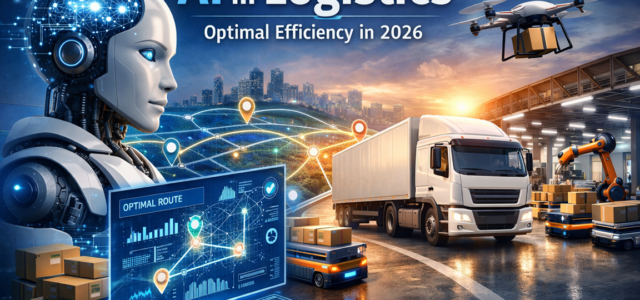
AI technologies are revolutionizing logistics in 2026, enabling companies to optimize routes, automate warehouses, predict demand, and reduce costs while meeting rising customer expectations for speed and transparency.
The most impactful applications today include predictive analytics, autonomous AI agents, smart fleet management, and AI-driven supply chain resilience.
📦 Introduction
Logistics is the backbone of global trade, but rising fuel costs, labor shortages, and unpredictable demand have made efficiency more critical than ever. Artificial Intelligence (AI) is now a competitive necessity, transforming logistics operations from reactive to predictive and proactive.
🚚 Key Applications of AI in Logistics
1. Route Optimization
AI algorithms analyze traffic, weather, and delivery constraints to determine the most efficient routes.
Reduces fuel consumption and delivery times.
Example: AI-powered dynamic routing systems cut transport costs by up to 15–20%.
2. Fleet Management
Predictive maintenance using AI sensors prevents breakdowns.
AI monitors driver behavior and fuel efficiency.
Autonomous AI agents are increasingly managing fleet scheduling and dispatch.
3. Warehouse Automation
AI-driven robots handle picking, packing, and sorting.
Computer vision improves inventory accuracy.
Smart warehouses reduce operational costs by 30–40%.
4. Demand Forecasting
AI predictive analytics anticipate demand fluctuations.
Helps avoid stockouts and overstocking.
Improves customer satisfaction with better availability.
5. Supply Chain Resilience
AI models simulate disruptions (e.g., geopolitical events, pandemics).
Enables proactive contingency planning.
Strengthens long-term sustainability.
📊 Efficiency Gains from AI
| AI Application | Efficiency Impact | Example Benefit |
| Route Optimization | 15–20% cost savings | Faster deliveries |
| Fleet Management | 25% fewer breakdowns | Lower maintenance costs |
| Warehouse Automation | 30–40% cost reduction | Higher throughput |
| Demand Forecasting | 20% inventory accuracy improvement | Reduced waste |
| Supply Chain Resilience | Faster recovery from disruptions | Greater reliability |
🔑 Challenges & Risks
High implementation costs for AI systems.
Data privacy concerns with real-time tracking.
Workforce adaptation: retraining employees to work alongside AI.
Integration complexity with legacy systems.
🌍 Future Outlook
By 2026, AI is no longer experimental but fully embedded in logistics operations.
Autonomous AI agents are becoming operational players across supply chains.
Companies that fail to adopt AI risk falling behind competitors in speed, cost, and customer satisfaction.
✍️ Conclusion
Applying AI in logistics today is about achieving optimal efficiency through smarter decisions, predictive insights, and automation. From route planning to warehouse robotics, AI is reshaping logistics into a leaner, faster, and more resilient system.
