Global maritime trade is the backbone of international commerce, with over 80% of goods transported by sea. The efficiency of shipping routes is therefore a critical determinant of supply chain reliability, cost-effectiveness, and geopolitical resilience.
Two of the most strategically significant maritime passages are the Strait of Hormuz and the Cape of Good Hope. While the Strait of Hormuz has historically been indispensable for energy exports from the Middle East, the Cape of Good Hope has served as a fallback route during times of crisis.
In 2026, the global logistics landscape is undergoing profound shifts. Escalating conflicts in West Asia have severely disrupted traffic through the Strait of Hormuz, while the Cape of Good Hope has emerged as a stable, albeit longer, alternative.
This article provides a comprehensive analytical comparison of the efficiency of ships passing through these two routes, considering historical context, current geopolitical realities, economic implications, and future outlooks.
1. Historical Context of the Two Routes
1.1 The Strait of Hormuz
Located between Oman and Iran, the Strait of Hormuz is only 21 nautical miles wide at its narrowest point.
It has long been considered the world’s most critical energy chokepoint, with nearly 20% of global oil and LNG flows passing through it in normal times.
Its efficiency stems from its short transit distance, connecting the Persian Gulf directly to the Arabian Sea and onward to Asia, Europe, and Africa.
However, its vulnerability to geopolitical tensions has always been a concern. From the Iran-Iraq War in the 1980s to recent conflicts, the Strait has repeatedly faced threats of closure or disruption.
1.2 The Cape of Good Hope
Situated at the southern tip of Africa, the Cape of Good Hope was historically the primary route for European-Asian trade before the Suez Canal opened in 1869.
It remains a vital alternative when the Suez Canal or Middle Eastern routes are blocked.
Though longer, the Cape route offers geopolitical stability, as South Africa and surrounding waters are relatively free from military conflict.
Its efficiency lies in predictability: ships can rely on uninterrupted passage, albeit with higher fuel and time costs.
2. Current Geopolitical Situation (2026)
2.1 Strait of Hormuz
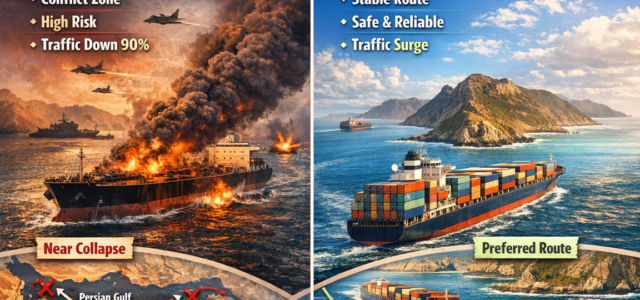
Since late 2025, escalating military tensions in West Asia have led to near-collapse of traffic through Hormuz.
Insurance premiums for vessels transiting Hormuz have skyrocketed, with war-risk surcharges making passage economically unviable.
Attacks on tankers and blockades have reduced traffic by 81–90%, effectively crippling its role in global logistics.
Exporters in the Middle East face bottlenecks, forcing rerouting through alternative pipelines or maritime routes.
2.2 Cape of Good Hope
Traffic through the Cape has surged dramatically as shipping companies reroute vessels to avoid Hormuz and the Red Sea.
South African ports such as Cape Town and Durban are experiencing congestion but remain operational.
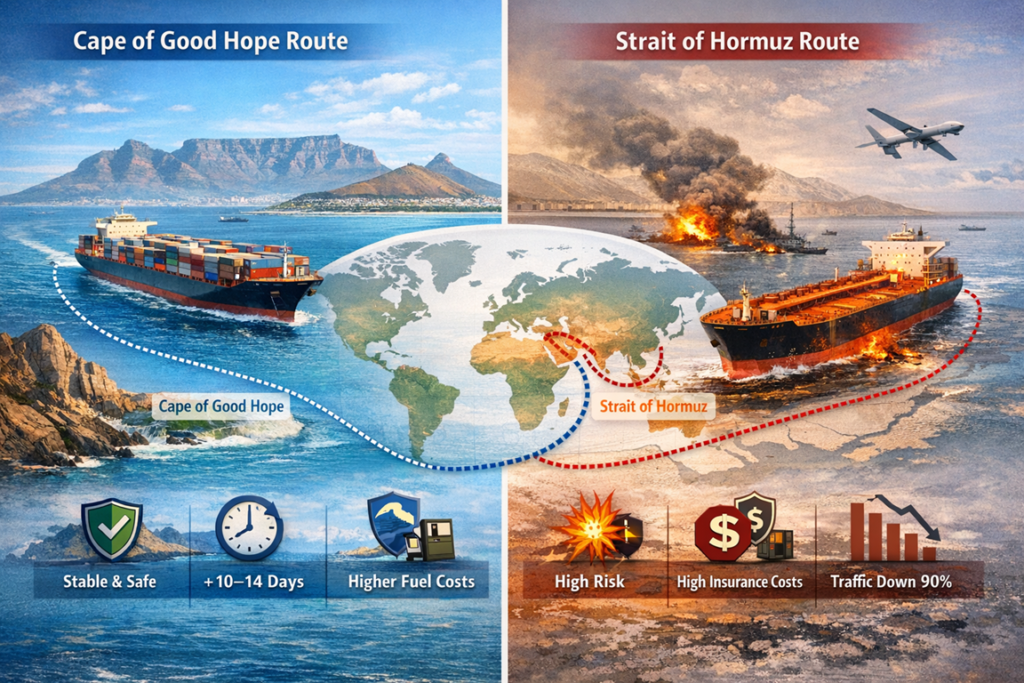
The Cape route adds 10–14 days to transit times compared to the Hormuz-Suez route, but its stability makes it preferable.
Insurance costs remain moderate, and risks are limited to natural weather challenges rather than geopolitical instability.
3. Efficiency Metrics
To evaluate efficiency, we consider several dimensions: transit time, safety, insurance costs, reliability, fuel consumption, and port congestion.
| Factor | Strait of Hormuz | Cape of Good Hope |
|---|---|---|
| Transit Time | Shorter (when open) | Longer (+10–14 days) |
| Safety | High risk (conflict zone) | Stable, low risk |
| Insurance Costs | Extremely high | Moderate |
| Reliability | Severely disrupted | Consistent |
| Fuel Costs | Lower (shorter distance) | Higher (longer distance) |
| Port Congestion | Reduced (due to collapse) | Increased (due to rerouting) |
4. Economic Implications
4.1 Cost Trade-Offs
Hormuz Route (Normal Times): Lower fuel costs and shorter transit times make it highly efficient.
Cape Route (Current Times): Higher fuel and time costs, but predictability outweighs risks of Hormuz.
4.2 Supply Chain Planning
Logistics companies prioritize certainty over volatility.
The Cape route allows better scheduling and reduces risk of sudden disruptions.
Longer lead times are factored into contracts, but reliability ensures smoother operations.
4.3 Regional Impact
Middle East Exporters: Face bottlenecks and reduced competitiveness due to Hormuz disruptions.
African Ports: Gain strategic importance, with increased traffic boosting local economies.
Asian Importers: Adjust to longer lead times, with China, India, and Japan diversifying supply chains.
5. Risk and Resilience
5.1 Strait of Hormuz
Vulnerable to geopolitical shocks.
Efficiency collapses under conflict.
Even when open, risk premiums erode cost advantages.
5.2 Cape of Good Hope
Natural risks (storms, currents) are manageable with modern navigation.
Offers resilience against geopolitical instability.
Increasingly seen as a permanent fixture in global trade strategies.
6. Case Studies
6.1 Oil Tankers
In 2026, most oil tankers bound for Asia bypass Hormuz, rerouting via the Cape.
Though costs rise, predictability ensures uninterrupted supply.
6.2 Container Shipping
Major shipping lines (Maersk, MSC, CMA CGM) have shifted routes southward.
Congestion at South African ports is a challenge, but overall efficiency remains higher than risking Hormuz.
6.3 LNG Exports
Qatar and other Gulf states face severe challenges exporting LNG.
Alternative pipelines and Cape rerouting partially mitigate disruptions, but efficiency is compromised.
7. Comparative Analysis
7.1 Short-Term Efficiency
Cape route is currently more efficient due to stability.
Hormuz route is effectively unusable under present conditions.
7.2 Long-Term Outlook
If Hormuz stabilizes, it will regain efficiency advantages.
However, logistics planners increasingly factor resilience and risk avoidance, making the Cape route a permanent option.
8. Future Scenarios
8.1 Optimistic Scenario
Peace returns to West Asia.
Hormuz reopens, regaining efficiency.
Cape remains as backup route.
8.2 Pessimistic Scenario
Conflicts persist.
Hormuz remains unusable.
Cape becomes primary global route, reshaping logistics.
8.3 Balanced Scenario
Partial reopening of Hormuz.
Diversification of routes continues.
Cape and Hormuz both play roles, with Cape as resilience option.
9. Conclusion
At present, the Cape of Good Hope route is more efficient in logistics operations compared to the Strait of Hormuz. While longer and costlier, its stability and predictability outweigh the risks and disruptions of Hormuz.
